Marketing
Why your marketing isn't generating leads: the 5-Bucket Audit
When marketing isn't generating leads, the problem almost always sits in one of five places. A 30-minute audit to find yours, and how to decide what to fix first.
Prince Kumar · · 12 min read
The short answer
When marketing isn't generating leads, the problem almost always sits in one of five places. People aren't finding you, they don't see their problem in what you say, they don't trust you yet, they can't tell why you over anyone else, or they go cold and never hear from you again. Find that one place and fix it first.
I call these the five buckets: Attention, Relevance, Credibility, Differentiation and Follow-up. Below is the test I run for each, and how to decide what to fix first.
Why I stopped starting with tactics
Most founders who come to us open the first call the same way. "We post every day and nothing happens." "Our ads get clicks but no orders." Or simply: "We need more leads."
By then they have usually picked a fix too: more ads, a new website, someone to run Instagram. More often than not, it's aimed at the wrong place. A brand buys more traffic when its product page is what's losing people.
So before I touch a single channel, I ask a plain question: what has to be true for someone to buy from you? I keep landing on the same five things, in the same order:
- Attention. Are the right people finding you at all?
- Relevance. When they see your marketing or your page, do they see their own problem?
- Credibility. Do they feel safe trusting you with it?
- Differentiation. They may feel safe with three other options too. Why you?
- Follow-up. If they're interested but not ready today, do you stay with them until they are?
Posting more and a bigger ad budget aren't on the list. Those are tactics, and every tactic either strengthens one of these buckets or it's noise. Prospects flow through the buckets in order, and a crack anywhere loses everyone below it.

How to use this article: set aside 30 minutes and be honest. Each bucket ends with a score: 0 (broken), 1 (weak) or 2 (working). You'll add them up at the end.
Bucket 1: Attention. Are the right people finding you?
Nothing downstream matters if the right people never arrive.
The test: write down your three biggest sources of new prospects. Look at your last 10 to 20 customers and ask how each one first heard of you.
If you can't name three, that is your first problem. A very common answer is "referrals, and Instagram, I think." The "I think" is the finding.
If you can name three, check each one:
- Can you put a rough number on it? Leads per month, even an estimate.
- Does it bring the right people, or just people? Ten enquiries from buyers who can afford you beat a hundred who can't.
- Does it work without you? If the source is your personal network, it stops the week you stop.
- Is one source more than half your business? Then you have a dependency, not a channel mix. One algorithm change and the pipeline dries up.
| Business | Typical sources of new prospects |
|---|---|
| D2C brand | Meta and Instagram ads, marketplace search, creators |
| Restaurant or cafe | Google Maps, Zomato and Swiggy, walk-ins |
| B2B or SaaS | Referrals, the founder's LinkedIn, outbound and events |
From our work: Snap India Trip, a brand bringing foreign travellers to India, came to us at day zero with no sources at all. We built attention as a set: a website and content that rank, a marketing engine, and partnerships with destination management companies. Organic inbound leads grew 2.4×, and those partnerships grew 6×.
If this bucket is broken: don't open five channels at once. Pick the one place your buyer already looks when the problem hits them, and commit to it for 90 days before adding the next.
Score it:
- 0: you can't name three sources, or don't know where customers come from.
- 1: you can name three, but one dominates or most of them depend on you.
- 2: three sources you can measure, none above half your business, and at least one runs without you.

Bucket 2: Relevance. Do they see themselves in what you say?
Attention puts you in front of people. Relevance decides whether they stop and stay: they scan for one answer, "Is this for me?" Test it in two places: your marketing and the page they land on.
Your marketing itself
People stop scrolling when they recognise their own problem; polish rarely does it. If the right people see your marketing and scroll past, that's Relevance.
The test: pull up your last 10 ads, reels or posts. For each, ask: in the first line or the first three seconds, would your ideal customer see their own problem or desire? Is it about them, or about you? Product shots with a discount, festival greetings and team photos are about you. If fewer than half pass, your marketing is talking to itself.
Most weak marketing isn't badly made; it starts from the wrong place. Strong marketing starts from a written list of the problems, questions and objections your buyers actually have. To see which creatives land, compare your own three-second view rates, click-through rates and saves against each other, not against someone else's benchmark.

Your first screen
The test: show the first screen a new prospect sees (your homepage, Instagram bio or listing) for 30 seconds to someone who fits your customer profile but doesn't know you. Then ask: "Who is this for, and what problem does it solve?" If their answer doesn't match yours, the bucket is leaking.
The usual cause is writing about yourself instead of the buyer. Founders write what they're proud of. Buyers are looking for what hurts:
| Business | Before: about the company | After: about the buyer's problem |
|---|---|---|
| Marketing agency | "A full-service digital agency with a passion for innovation." | "Your ads get clicks, but your store doesn't get orders. We fix what happens in between." |
| Cafe | "A cosy space serving artisanal coffee." | "Quiet tables, fast Wi-Fi and good coffee for people who work from cafes." |
Match the page to where the visitor came from, too. Someone who clicked an ad for one product shouldn't land on a homepage about everything.
From our work: with Zoku Zest, a D2C apparel brand for anime fans, we spent more time understanding how their customers think about anime, streetwear and price than making the first ad. That research is what relevance actually is, and the marketing spoke to the community it was made for. The brand now runs at 21× return on ad spend.
If this bucket is broken: talk to five recent customers before you rewrite anything. Write down the words they use to describe their problem, then use those exact words in your first line and in the opening seconds of your next ads.
Score it:
- 0: a stranger can't say who you're for, or most of your marketing is about you rather than them.
- 1: they understand what you do, but your page or creatives don't show why it matters to them.
- 2: they describe the problem back to you in their own words, and your best creatives open with it.

Bucket 3: Credibility. Do they feel safe buying from you?
Relevance makes people interested. Credibility makes them feel safe. Buyers often don't pick the option that looks best; they pick the one that feels least risky.
The test: find at least three places, on your website, profile or sales deck, that give a stranger a real reason to believe you're good at what you do: a client story with an outcome, a result with a number, reviews, or a guarantee. "Trusted by hundreds of happy customers" and "Great work! — R.K." don't count.
If you can't find three, this is your bucket. If you can, check the proof you have:
- Is it specific? "A shorter sales cycle" is a claim. "41% shorter" is proof.
- Is it where the decision happens? Proof belongs next to the price, the form or the booking button. A testimonials page nobody visits does very little.
- Is it the proof this buyer trusts? A D2C shopper trusts reviews and customer photos. A B2B buyer trusts case studies and named clients.
New, with little proof yet? Useful advice is the one form of credibility you can start building today.
From our work: Mithila Shri sells certified Rudraksha, gemstones and Mithila art online, where the buyer's first fear is "Is this genuine?" No ad answers that; trust has to be earned on the page itself. The online store, presence and community we built lifted their website visit-to-sale conversion 1.6×.
If this bucket is broken: collect three proof points this month. Ask your three happiest customers for a short story with one number in it, and place each one beside the action you want people to take.
Score it:
- 0: fewer than three real reasons to believe you, anywhere.
- 1: proof exists, but it's vague or hidden away from the buying moment.
- 2: specific proof, matched to the buyer, placed where they decide.

Bucket 4: Differentiation. Why you, and not the next tab?
A buyer who trusts you probably trusts two or three others too. When nothing separates you, the comparison usually collapses into price, and the cheapest option wins.
The test: write down one specific reason someone should choose you, in one sentence. These are banned: "great service", "quality", "30 years of experience", "passionate team", "customer-first", "affordable". Then run the copy-paste check: could your closest competitor put your sentence on their website without changing a word? If yes, it isn't a difference. It's a category description.
Real differences come from who you serve, how you work, what you promise or what you've proven, and a buyer has to be able to check them. One of ours: "The senior people you meet on the first call are the people who do the work." It isn't an adjective, and it can be verified in the first month.
Sometimes this test shows there is no real difference yet. Better words won't solve that; it's a business decision about your customer or your offer, and the slowest bucket to fix.
If this bucket is broken: list the last five deals you lost and why, or read your reviews and DMs for who you're compared with. If the answer is mostly "price", the buyer saw no difference worth paying for.
Score it:
- 0: your reason uses the banned words, or a competitor could say it unchanged.
- 1: a real difference exists, but it isn't stated clearly where buyers compare.
- 2: one specific, checkable reason, said the same way everywhere.

Bucket 5: Follow-up. What happens to people who aren't ready today?
Most people who show interest won't buy that day, because the timing is wrong. The business that stays in touch wins them when it turns right.
The test: imagine someone becomes genuinely interested today but won't be ready for six months. Do they hear from you next week? In month four? Or do they simply disappear?
For most businesses, they disappear, after you've paid to bring them in. The good news: follow-up is often the cheapest bucket to fix, because it earns from leads you already have. Four checks:
- Capture: do you collect a way to reach them (a WhatsApp opt-in, an email, a form) before they leave?
- Sort: do serious buyers get speed while the rest get nurtured? When every enquiry gets the same treatment, your best leads wait in the queue.
- System: does follow-up run on its own, or does it depend on someone remembering?
- Value: does each message give them a reason to come back, or is it "just checking in"?
From our work: Outrive Trails runs mentor-led trips for founders. Every enquiry got the same attention, so serious founders waited behind people who were never going to book. We built a funnel that sorts them first and nurtures the rest automatically; the average sales cycle is now 41% shorter.
If this bucket is broken: set up one automated sequence for the people who said "not now". With their permission, send five messages over 90 days, each one useful on its own. Speed matters too: a fresh enquiry answered within the hour is a very different lead from one answered next week.
Score it:
- 0: interested people disappear unless someone remembers to call.
- 1: some follow-up happens, but it's manual or generic.
- 2: contacts are captured and sorted, and useful follow-up runs on its own for months.

Score yourself, then fix one bucket
Add up your five scores. The total, out of 10, matters less than where your zeros are.
| Bucket | The question | Your score (0, 1 or 2) |
|---|---|---|
| Attention | Are the right people finding you? | |
| Relevance | Do your marketing and pages speak to their problem? | |
| Credibility | Do they feel safe buying from you? | |
| Differentiation | Why you, and not the next option? | |
| Follow-up | Do you stay with people who aren't ready yet? |
Why one broken bucket costs more than it looks
The buckets multiply; they don't add. Picture 1,000 visitors a month where 1% become leads: 10 leads. Doubling ad spend gets you 20 at best, at double the cost. Fixing the first screen so 2% become leads also gets you 20, with no extra spend. More attention poured into a leaking bucket just leaks faster.
What to fix first
- Fix a 0 before you polish a 1. A broken bucket caps everything below it.
- Don't buy more attention while Relevance or Credibility is 0. Fix the page first, then scale the traffic.
- With several zeros and a list of past enquiries, start with Follow-up. It earns from people you've already paid to reach, so it usually pays back fastest.
Work on that one bucket for 30 to 60 days, score all five again, and move to the next. Founders who fix all five at once usually fix none, because nobody can tell which change moved the number.
Frequently asked questions
What is the 5-Bucket Audit? A 30-minute diagnostic for finding why marketing isn't producing leads or sales. It checks five things, including your ads and content, in the order a buyer experiences them: attention, relevance, credibility, differentiation and follow-up. Each gets a score from 0 to 2, and the lowest score tells you where to start.
My leads come in but don't turn into sales. Which bucket is that? Look at where deals stall. If prospects go quiet before the first real conversation, check credibility. If they compare you and push on price, it's differentiation. If they say "let me think about it" and are never heard from again, it's follow-up.
What if I score well on all five and sales still don't come? Then marketing probably isn't the problem. Check your tracking first: leads may be arriving where nobody is looking. Then the offer: no marketing fixes a product people don't want enough. Then ask ten people who almost bought why they didn't.
Does this work for B2B and SaaS, or only consumer brands? It works for both. A consumer moves through the five buckets in minutes; a company buying software may take months. The questions are the same; only the time between them changes.
Can I run this without an agency? Yes, it's built to be done alone. The one part where outside eyes help is relevance: you're too close to your own words to read them like a stranger.
Find your broken bucket
Download the 5-Bucket Audit scorecard (a one-page PDF) and score your business in 30 minutes.
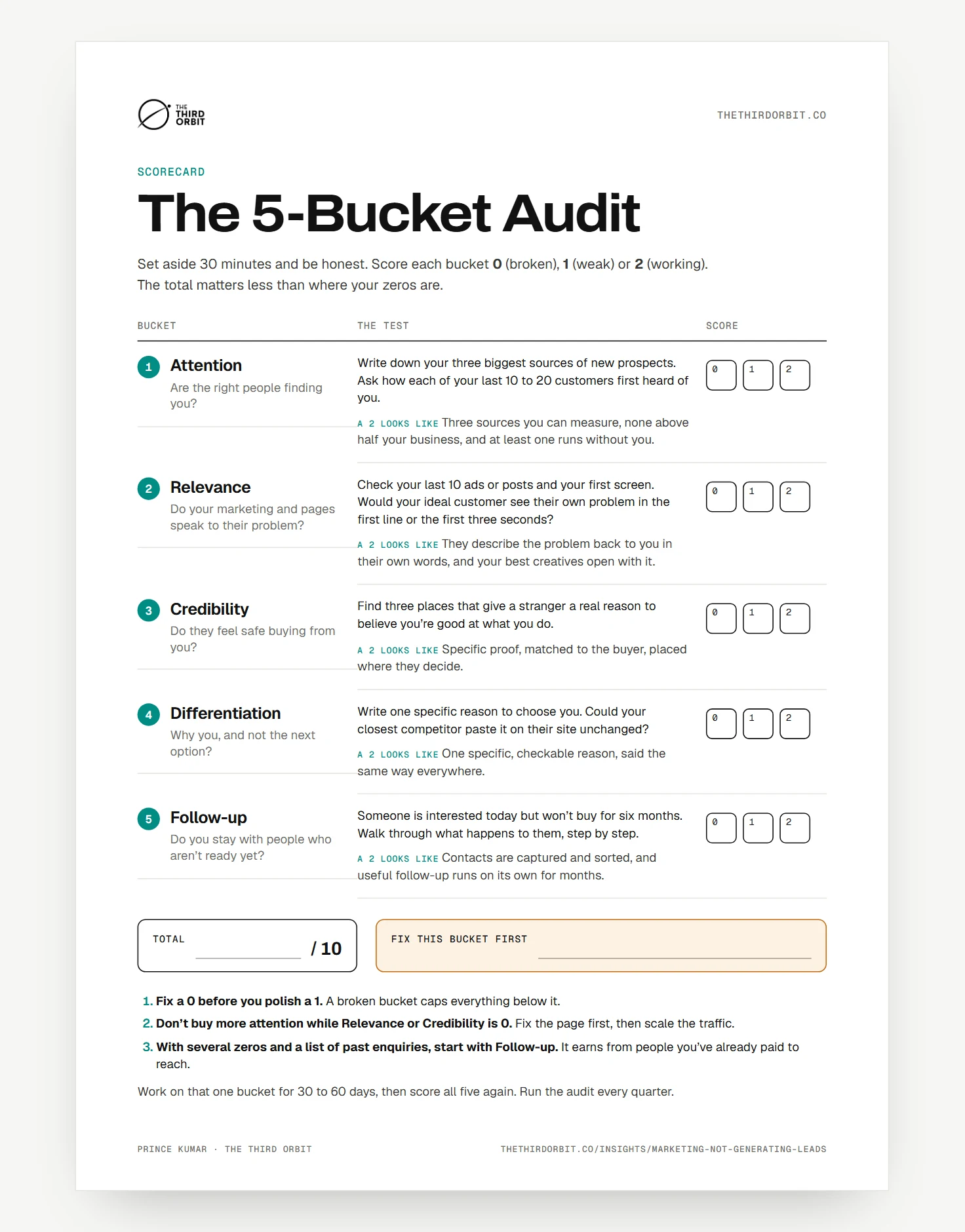
Then send us your scores. We'll book a free 30-minute review, look at your weakest bucket with you, and tell you plainly what to fix first. No pitch deck, no generic proposal.
If you already know where the leak is, see how we build sales funnels and marketing that close it.